

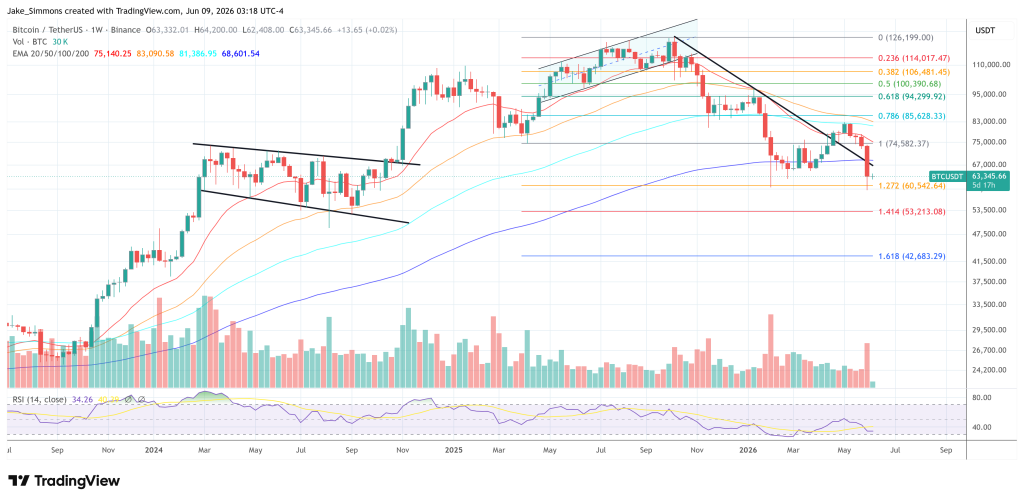
Coinbase’s head of institutional strategy, John D’Agostino, says large investors are not retreating from Bitcoin’s latest selloff, even after the asset fell below $60,000 for the first time since October 2024. Speaking on CNBC’s Squawk Box on June 8, D’Agostino said institutional investors, family offices and sovereign-linked buyers are treating the drawdown as an opportunity to accumulate rather than a reason to exit.
The remarks came during a discussion about whether Bitcoin’s decline toward the $59,000 area could hold as support, with CNBC’s Joe Kernen noting concerns that a deeper break could open the door to a much larger move lower. D’Agostino declined to make a direct price call, saying he does not want to offer investment advice, but pointed to the behavior of long-term allocators he speaks with through Coinbase’s institutional business.
“What I can tell you is I have the luxury of speaking to institutional investors. They’ve put months and years into looking at this asset class. So when they do that and it’s cheaper, they like it,” D’Agostino said.
He added that some investors have defined price targets, while others are focused on long-term accumulation. According to D’Agostino, recent conversations in the Middle East suggest that major buyers are comfortable with the decline.
“I just got off a plane from the Middle East. And I can tell you that the family offices in the UAE and the government and sovereign funds that I’m putting the effort into buying this asset class are not unhappy at being able to buy it at a discount.”
Coinbase Exec Points To Stronger Bitcoin Infrastructure
D’Agostino’s core argument was not that Bitcoin’s price had necessarily found a floor, but that the institutional market around the asset is materially stronger than in prior drawdowns. He said Coinbase is seeing the “institutional piping” that supports Bitcoin and other crypto assets continue to develop through both bullish and bearish market environments.
Compared with previous CNBC appearances during stronger price conditions, he said the market now has a “shockingly stronger level of infrastructure.” That infrastructure, he argued, is what many institutional investors are focused on when assessing whether Bitcoin is becoming a more durable long-term allocation.
He also pointed to spot ETFs as evidence that retail and institutional demand has not collapsed alongside price. D’Agostino said there is still roughly $100 billion of Bitcoin ETF exposure, describing the products as “very, very new.” Despite Bitcoin being down almost 50% from its peak, he said retail interest has seen only about a 15% drawdown.
“So I think both retail and institutional are signaling this is a long term asset you want to hold,” he said.
Macro Pressure, Leverage And Market Structure
Asked to explain the selloff, D’Agostino said Kernen had identified the main consensus factors: risk-off positioning, investors selling liquid assets to fund other opportunities, higher-for-longer interest rates, weaker support for the debasement trade and uncertainty around regulatory clarity. He did not frame those pressures as irrelevant, but argued that volatility is a feature of long-duration commodity-like assets.
“Volatility is a funny thing, right? If I told you a year ago, we’d be 100 days into a war with Iran with the Strait of Hormuz being closed and no clear sight of line to it being open. Would you think that crude would still be trading under 100 bucks a barrel?” D’Agostino said.
He said his background leads him to think of Bitcoin as a commodity-style asset, where volatility can come and go while long-term demand remains intact. He also pointed to pending policy work in Washington, saying that market structure and tax reform may be unexciting topics but could be important for institutional adoption. “We have seven bills circulating that will do great things for the institutional piping that supports Bitcoin and other crypto assets,” he said.
On leverage, D’Agostino said he is not aware of any large institutional Bitcoin holders that are “horrifically over levered” at levels close enough to create a specific forced-selling threshold. He contrasted that with retail traders on offshore exchanges, where extreme leverage can result in rapid liquidations during liquidity shocks.
“For some of the larger entities that hold Bitcoin with leverage, they seem to have an endless ability to go into the market and bring in more capital to support their buying activities,” he said.
D’Agostino closed by saying he is not seeing institutional panic. Instead, he said large allocators are evaluating the cheapest ways to raise new capital and increase exposure to an asset they “loved at $125k,” “liked at $100k” and “love even more at $65k.”
At press time, BTC traded at $63,345.












 Svenska
  English
  Română
  Eesti
Eesti  한국어
한국어  日本語
日本語  Русский
  Deutsch
  Español
  简体中文
简体中文  Français
  繁體中文
繁體中文  Português
  Italiano
  Polski
  Türkçe
  Nederlands
  Bahasa Indonesia
  Ελληνικά
  Українська
  Български
  Čeština
  Suomi
Suomi  Magyar
  Latviešu valoda
  Lietuvių kalba
  Norsk bokmål
  Slovenčina
  Slovenščina
Lämna ett svar