

A lawsuit accusing the crypto exchange Binance of allowing terrorism financing by facilitating it has fallen apart after a US Federal court dismissed it.
Not Terrorist Supporters
The Troell et al. v. Binance case was dismissed in an opinion and order issued on March 6 by Judge Jeannette A. Vargas of the U.S. District Court for the Southern District of New York. The defendants’ motions were granted against a complaint brought by 535 plaintiffs, all of whom were victims or family members of victims of terrorist attacks.
The Accusation
The plaintiffs accused Binance, Changpeng “CZ” Zhao (its founder and former CEO) and BAM Trading Services (the company behind the Binance.US exchange) of facilitating 64 terrorist attacks carried out between 2016 and 2024. They claimed that Binance, Zhao and BAM Trading allowed wallets allegedly tied to Hamas, Hezbollah, ISIS, al‑Qaeda, Palestinian Islamic Jihad (PIJ) and Iranian proxies to move funds, amounting to aiding and abetting terrorism under the U.S. Anti‑Terrorism Act and the Justice Against Sponsors of Terrorism Act (JASTA).
Why The Crypto-Terror Financing Case Fell Apart
The court granted the motions to dismiss under Rule 12(b)(6), finding that the complaint failed to plausibly allege that Binance “knowingly provided substantial assistance” to the specific attacks at issue.
The Judge’s Two Big Criticisms
Judge Jeannette Vargas’s opinion is based on two fundamental weaknesses she identified in the plaintiffs’ theory. First, although the complaint leaned heavily on blockchain traces, sanctions‑list designations and reports of terrorist groups using Binance, it did not plausibly show that Binance, Zhao or BAM Trading knew at the time that specific wallets on the platform were controlled by FTO (Foreign Terrorist Organization) or their close associates.
Second, the court held that the plaintiffs failed to connect the alleged crypto flows on Binance to the 64 terrorist attacks they invoked. The complaint mapped out millions of dollars in transactions involving “FTO‑associated” or Iran‑linked wallets and described a broad ecosystem built to fund operations, but it did not identify who owned the wallets at issue, when specific transfers took place, what role those transfers played in operational planning. It also didn’t identify how any given Binance‑processed transaction materially advanced the specific bombings, rocket attacks, shootings, hostage‑takings, or the Wizard Spider ransomware incident that harmed the 535 plaintiffs.
The Law Behind The Reasoning
Under the U.S. Anti‑Terrorism Act and JASTA (The Justice Against Sponsors of Terrorism Act), it is not enough to show that designated terrorist organizations or sanctioned Iranian actors touched a platform at some point in time. Victims must plausibly allege that the defendant knew who it was dealing with and that its conduct was closely linked to the attacks at issue, not just to terrorism “in general.”
In this case, the judge held that generalized allegations about “terrorist‑associated wallets” on Binance, and references to lax KYC (Know Your Customer), VPN loopholes, and U.S. user evasion, did not amount to a concrete showing that Binance’s services materially advanced the operations that the plaintiffs suffered.
Plaintiffs still have 60 days to refile, so, in truth, Binance is not entirely out of the woods yet. Besides, Binance remains under intense scrutiny: the exchange is still navigating a $4.3 billion AML and sanctions plea deal, a court‑appointed monitor, and political pressure in Washington over alleged terror‑finance exposure, as detailed by Bitcoinist and NewsBTC.
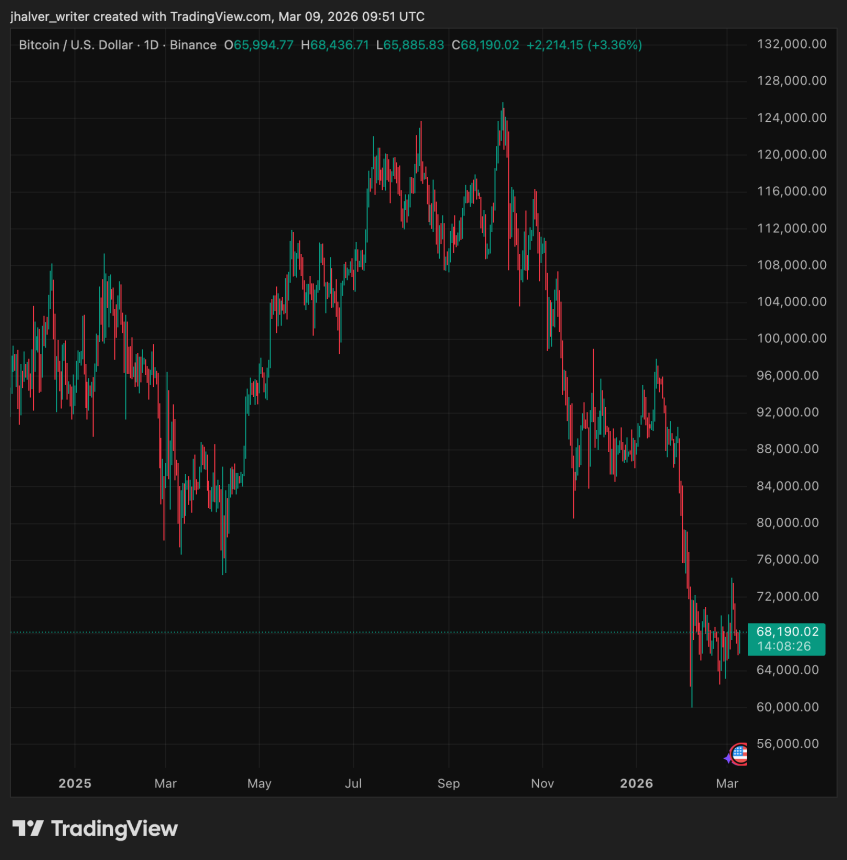
Cover image from ChatGPT, BTCUSD chart from Tradingview











 Svenska
  English
  Română
  Eesti
Eesti  한국어
한국어  日本語
日本語  Русский
  Deutsch
  Español
  简体中文
简体中文  Français
  繁體中文
繁體中文  Português
  Italiano
  Polski
  Türkçe
  Nederlands
  Bahasa Indonesia
  Ελληνικά
  Українська
  Български
  Čeština
  Suomi
Suomi  Magyar
  Latviešu valoda
  Lietuvių kalba
  Norsk bokmål
  Slovenčina
  Slovenščina
Lämna ett svar