

XRP has reclaimed key price levels and is now testing resistance as the market builds toward what looks like a decisive move. The price is accelerating — from $1.41 at the time of the data snapshot to past $1.45 shortly after — and the momentum is drawing attention. But an XWIN Research Japan analysis is arguing that the force behind this move is different from what has driven XRP rallies in the past, and that difference is worth understanding.
The report identifies what it describes as a rare structural divergence. In most crypto markets, exchange speculation dominates. Trading volumes on centralized exchanges typically run 10x, 20x, sometimes 50x higher than actual on-chain utility. The assumption baked into most crypto price analysis is that speculation is the engine and real use is the passenger.

For XRP, that ratio has compressed to 1.75. On-chain settlement volume stands at 291 million XRP. Aggregate speculative volume sits at 510 million. The gap between the casino and the infrastructure has nearly disappeared. And in the context of how crypto markets normally operate, that is genuinely unusual.
What it suggests is that the price is not being pushed by traders chasing momentum. It is being pulled by adoption. The network is being used at a scale that is nearly matching the volume being traded around it — and according to the analysis, that changes everything about what the current price level means.
The Network Is Active. The Exchanges Are Nearly Empty
The supporting duomenys behind the speculation-to-utility ratio removes any ambiguity about what is driving the current XRP move. Active addresses on the XRP Ledger reached 17,329 in the past 24 hours — a reading that broke above the weekly average and confirms that network participation is genuinely expanding, not just speculative volume inflating the numbers. Real accounts are conducting real transactions.
Then there is the Binance inflow figure, which is the most striking data point in the entire report. While 291 million XRP settled on the blockchain — institutional remittances, OTC transactions, custody movements — only 1.36 million XRP entered Binance. In markets where exchange inflow typically tracks or exceeds on-chain activity, this ratio now almost inverts. The overwhelming majority of XRP moving through the network is going nowhere near the sell side.
That is the supply shock the analysis has been building toward. When coins are being used for legitimate settlement and custody rather than deposited on exchanges to be sold, the available liquid supply tightens with every transaction. Selling pressure cannot come from coins that never arrive at exchanges.
The report’s conclusion is direct: at $1.41, the price has not yet caught up to what the on-chain data is describing. The adjustment, it argues, is still in its early stages — and the network is already doing the work that makes it inevitable.
XRP Stabilizes Below Key Resistance
XRP’s higher-timeframe structure shows a market still in a corrective phase, but beginning to stabilize after an extended decline. Following the mid-2025 peak above $3.50, the price entered a sustained downtrend defined by consistent lower highs and a breakdown below the 100-day and 200-day moving averages. That trend accelerated into early 2026, culminating in a sharp selloff that briefly pushed XRP toward the $1.20 region, accompanied by a spike in volume that suggests capitulation.
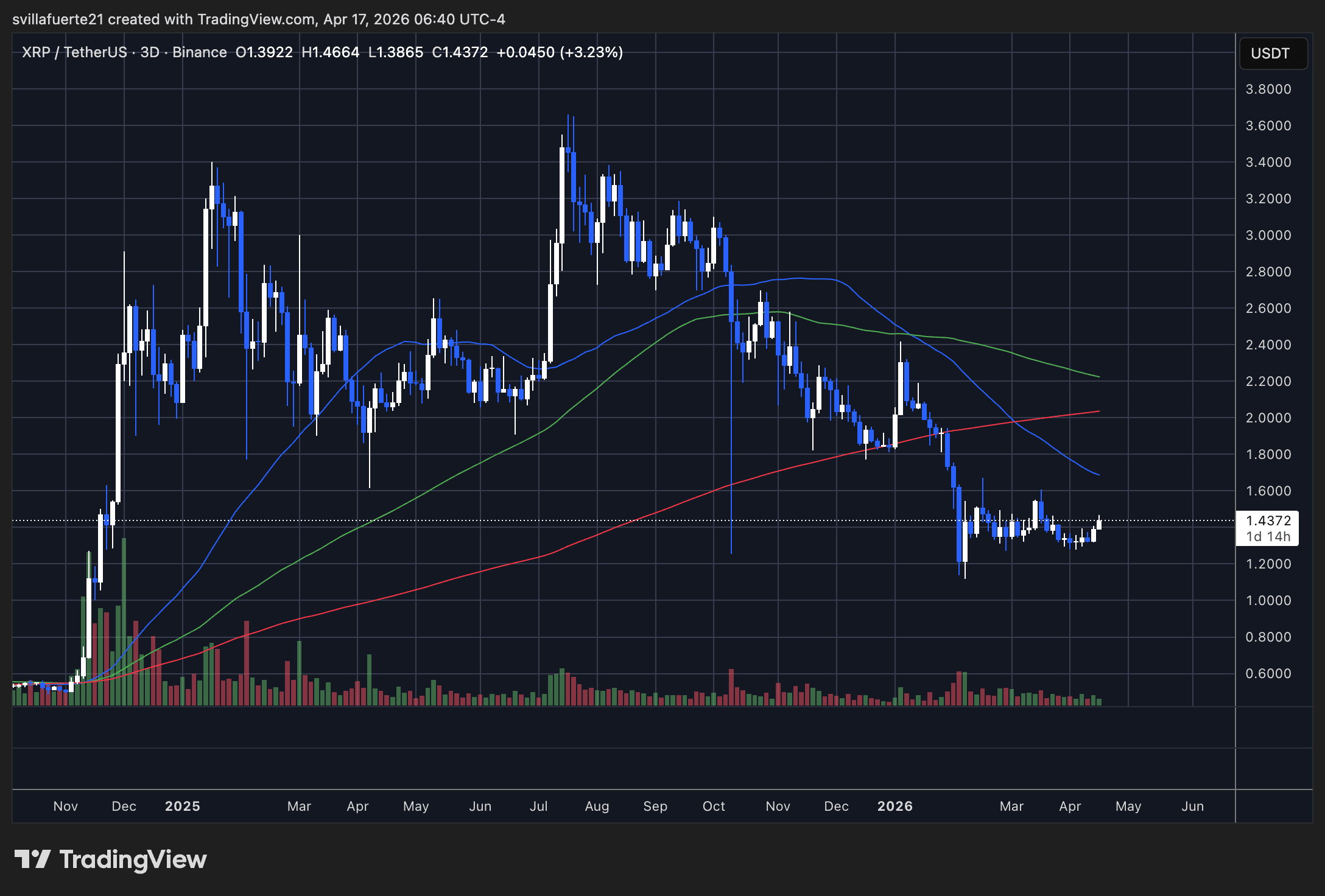
Since then, the price has shifted into a consolidation range between roughly $1.30 and $1.50. This range is forming just below the 200-day moving average, which continues to slope downward and acts as a key macro resistance level. The 50-day moving average has flattened and is beginning to curl upward, reflecting improving short-term momentum, but without yet confirming a structural reversal.
Volume has declined steadily following the capitulation event, indicating reduced participation and a market in wait-and-see mode. The repeated defense of the $1.30 area points to emerging demand, while the inability to break above $1.50 highlights persistent overhead supply.
This compression typically precedes expansion. A confirmed break above $1.50–$1.60 would signal a shift toward recovery, while a loss of $1.30 would likely resume the broader downtrend.
Featured image from ChatGPT, chart from TradingView.com












 Lietuvių kalba
  English
  Română
  Eesti
Eesti  한국어
한국어  日本語
日本語  Русский
  Deutsch
  Español
  简体中文
简体中文  Français
  繁體中文
繁體中文  Português
  Italiano
  Polski
  Türkçe
  Nederlands
  Bahasa Indonesia
  Ελληνικά
  Українська
  Български
  Čeština
  Suomi
Suomi  Magyar
  Latviešu valoda
  Norsk bokmål
  Slovenčina
  Slovenščina
  Svenska
Parašykite komentarą