

Uniswap (UNI) ripped higher on Tuesday after Uniswap Labs founder Hayden Adams unveiled “UNIfication,” a sweeping governance proposal that would activate protocol fees and route them into coordinated token burns. The structural shift—combined with a sharp change in how Uniswap’s teams are organized, igniting an extremely bullish sentiment, with CryptoQuant CEO Ki Young Ju arguing that a real supply shock could be incoming.
Uniswap (UNI) Supply Shock Incoming?
“Uniswap could go parabolic if the fee switch is activated. Even just counting v2 and v3, with $1T in YTD volume, that’s about $500M in annual burns if volume holds. Exchanges hold $830M, so even with unlocks, a supply shock seems inevitable. Correct me if I’m wrong,” Ki Young Ju wrote.
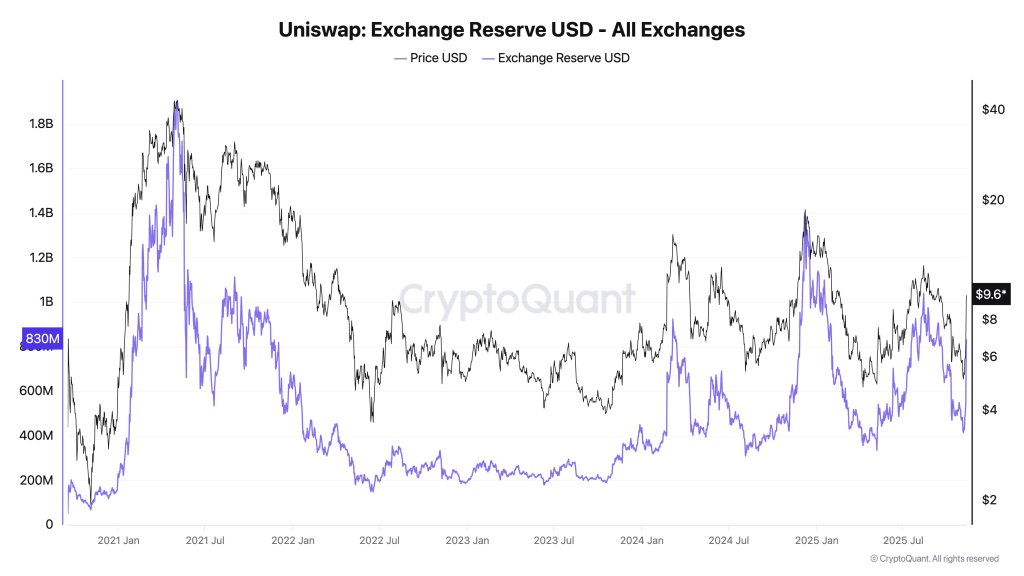
In a thread posted early Tuesday, Adams said he was “incredibly excited to make my first proposal to Uniswap governance,” describing a framework that “turns on protocol fees and aligns incentives across the Uniswap ecosystem.” He framed the move as the culmination of years of legal wrangling that had constrained Labs’ role: “UNI launched in 2020, but for the past 5 years Labs has been unable to meaningfully participate in Uniswap governance […] That ends today,” he wrote, adding that “the regulatory environment has shifted.”
The on-chain economics he outlined are unambiguous. Protocol usage would begin burning UNI; Unichain sequencer revenue would be directed to the same burn sink; and the treasury would immediately destroy 100 million UNI to account for fees that “could have been burned if fees were turned on at token launch.”
Adams also described new “protocol fee discount auctions” to improve LP outcomes and internalize MEV, and an “aggregator hooks” architecture in v4 that would let the protocol capture fees sourced from external liquidity.
In parallel, Uniswap Labs would stop charging fees on its interface, wallet, and API to push distribution and adoption, while Uniswap Foundation staff move to Labs under a growth mandate funded by the treasury. The net effect is a consolidation: Uniswap’s development, growth and fee policy would be operated under a single, explicitly token-aligned structure, with governance retaining control.
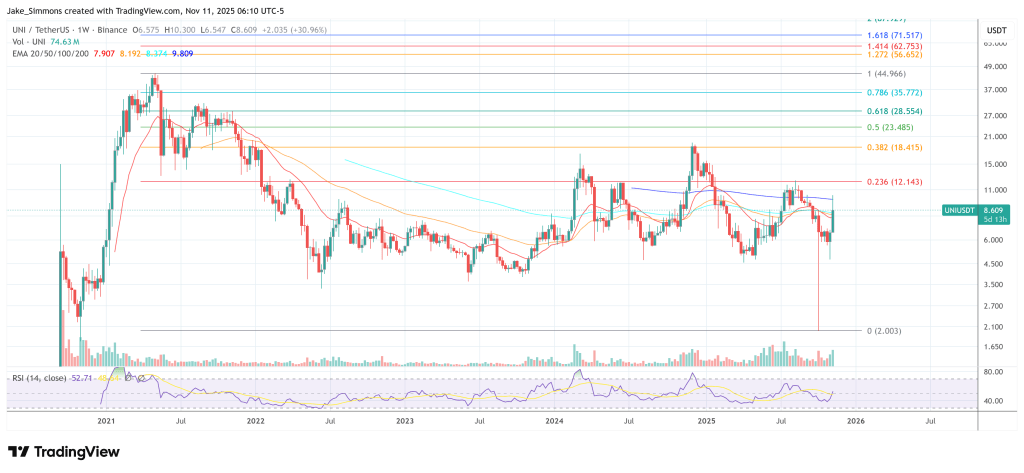
Price action reflected Ki Young Ju’s comment. UNI spiked to multi-week highs as coverage spread. In early European trading hours, UNI showed a one-day gain near 30% while many majors treaded water, underscoring UNI’s idiosyncratic governance-driven rally.
Beyond headline burns, the crux is whether the economic flywheel can be sustained without degrading liquidity provider economics. Historically, Uniswap governance has wrestled with “fee switch” design trade-offs and the risk of disintermediating LPs or pushing order flow elsewhere.
Adams argued this blueprint is different because fee proceeds are not distributed as passive yield but are instead destroyed to concentrate value into the remaining float, while discount auctions and MEV internalization are meant to keep LPs competitive on net execution. The full rationale and parameterization—fee rates, split between pools, cadence for auctions, and the exact mechanics of the burn—are laid out in the governance post now in “Requests for Comment,” with implementation subject to the usual forum review and on-chain governance process.
Adams cast the proposal as an existential scaling step: “I believe Uniswap protocol can be the primary place tokens are traded. This proposal sets the stage for the next decade of its growth […] Uniswap will ship relentlessly over the coming years and supercharge the ecosystem of developers, LPs, and traders,” he wrote.
According to estimates by MegaETH Labs member BREAD, if Uniswap were to modify its standard 0.3% trading fee so that 0.25% is allocated to liquidity providers and 0.05% directed toward UNI buybacks, the protocol could channel roughly $38 million into monthly repurchases. This projection is based on an annualized fee revenue of approximately $2.8 billion and would position Uniswap’s buyback capacity slightly above PUMP’s $35 million pace, yet still below HYPE’s $95 million benchmark.
At press time, UNI traded at $8.609.





 한국어
한국어  English
  Română
  Eesti
Eesti  日本語
日本語  Русский
  Deutsch
  Español
  简体中文
简体中文  Français
  繁體中文
繁體中文  Português
  Italiano
  Polski
  Türkçe
  Nederlands
  Bahasa Indonesia
  Ελληνικά
  Українська
  Български
  Čeština
  Suomi
Suomi  Magyar
  Latviešu valoda
  Lietuvių kalba
  Norsk bokmål
  Slovenčina
  Slovenščina
  Svenska
답글 남기기