

Bitcoin Magazine
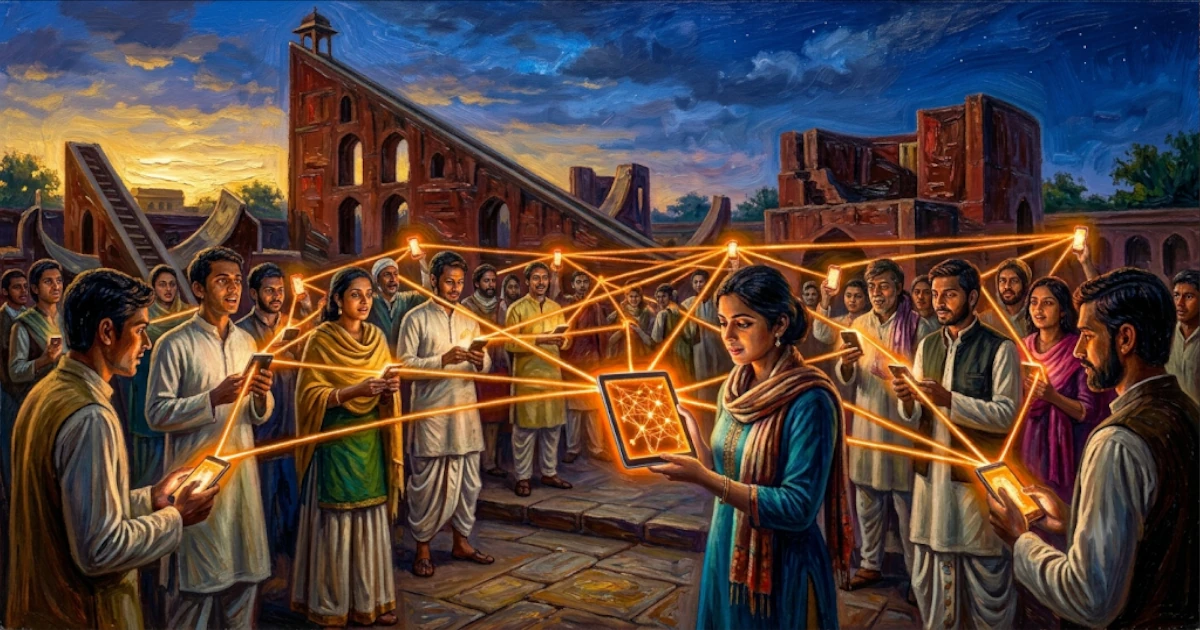
Bitchat Mesh App Defies India Cybercrime Notice After Protesters Use It During Network Restrictions
Bitchat, Jack Dorsey’s censorship-resistant, Bluetooth-enabled messaging app, has gone viral again, this time due to the Indian Government trying to get it banned from GitHub. In this latest round of authoritarian measures versus decentralized technologies, Bitchat has won.
In July 2025, Jack Dorsey announced a new messaging application he described as a weekend project. The app, called Bitchat, was designed to work without internet access, phone numbers, user accounts, or central servers. It relied instead on Bluetooth mesh networks for local communication and the Nostr protocol for wider reach.
A year later, that same application became the subject of a formal takedown request from India’s cybercrime authorities during a period of student protests. The episode offers a clear illustration of how cypherpunk ideas—building systems that function without permission from intermediaries—continue to shape tools used in moments of political tension.
Calle, one of the main developers behind the Android version of the app, took the statements from the Indian government as a positive review of Bitchat’s effectiveness, tweeting:
“India forces GitHub to take down Bitchat
‘Bitchat enables anonymous communication without mandatory user registration, phone number verification, or centralized logging of communications.
The technical architecture of the application significantly impedes interception, attribution, and investigation by law enforcement agencies.’ – Government of India”
What Bitchat Is
Bitchat is a peer-to-peer encrypted messaging application. Devices form local mesh networks over Bluetooth, automatically discovering nearby peers and relaying messages across multiple hops. When internet connectivity is available, the app can fall back to Nostr relays. Users can join public local channels, send private end-to-end encrypted messages, and access location-based channels organized by geographic zones.
The application requires no registration and includes a panic feature that clears stored data. The code is open source, with the primary repositories hosted under the permissionlesstech organization on GitHub. The iOS version is available on the App Store; the Android version is on Google Play and distributed via GitHub releases, as well as many other app stores like Nostr’s Zapstore. Recent updates added the ability for Android devices to share the installation file directly with nearby phones over Wi-Fi or Nearby Share, letting new users join the mesh easily without the need for internet access.
Key figures associated with the project include Jack Dorsey and open-source developer Calle, known for work on Cashu ecash. Bitcoin Magazine has previously noted experimental demonstrations of offline Bitcoin-related payments moving across the same mesh.
Earlier Deployments
Bitchat first saw significant real-world use during periods of government-restricted connectivity. In September 2025, during unrest in Nepal, the app recorded nearly 50,000 downloads from that country in a single day, according to data shared by Calle and reported by Bitcoin Magazine. Similar spikes occurred during blackouts in other regions. In January 2026, Iranian users turned to Bitchat and a localized fork during internet restrictions, as covered in Bitcoin Magazine.
These earlier cases established a pattern: when conventional mobile networks or social platforms become unreliable or restricted, tools that operate independently of those networks see rapid adoption.
The India Events
In May 2026, India’s National Eligibility Entrance Test (NEET-UG) for medical school admissions was canceled after evidence of a significant leak of the test’s questions. The controversy, involving millions of candidates, undermined the fairness of the exam and was linked to student suicides, contributing to the growth of a youth-led satirical movement known as the Cockroach Janta Party (CJP). Protests centered on demands for accountability from Education Minister Dharmendra Pradhan and broader reforms to the examination system.
By mid-July, demonstrators had gathered at Jantar Mantar in New Delhi and attempted marches toward Parliament. Reports indicated blackouts on mobile data or internet access in areas around the protests. On 24 July 2026, the Indian Cybercrime Coordination Centre (I4C), issued a notice directing GitHub to restrict access to three Bitchat repositories within three hours. The notice cited the application’s ability to function during network restrictions and internet shutdowns, arguing that this architecture could impede lawful interception and attribution.
On 24 July, Dorsey posted the notice on X with the statement: “the government of India does not like technologies like bitchat and wants it taken down.” Market data from Sensor Tower, according to TechCrunch, reported across multiple outlets, showed that India accounted for approximately 85 percent of the app’s global downloads between 17 and 23 July, with more than 91,000 downloads in India over five days and daily active users exceeding 330,000 at the peak.
The GitHub repositories remained accessible in the immediate aftermath, despite the takedown attempt by the Indian government. Developers and users circulated mirrors, including on decentralized platforms such as Radicle. The application itself continued to function on devices that already had it installed, and the offline file-sharing feature reduced reliance on app stores or GitHub for further distribution. Pradhan resigned on 25 July.
Historical Context
The use of messaging tools during protests is not new, nor is Dorsey’s role in support of technologies useful during tense democratic protests. During the Arab Spring, platforms such as Twitter and Facebook were widely credited with helping coordinate demonstrations and amplify information, leading some observers to describe the events as “Twitter revolutions” or “Facebook revolutions.” Those centralized services, however, remained dependent on internet access and corporate intermediaries that could be pressured or blocked and in some cases were.
A closer technological predecessor appeared in 2014 during Hong Kong’s Umbrella Movement. Protesters downloaded FireChat, a mesh-networking application that allowed devices to communicate directly over Bluetooth or Wi-Fi without internet. The app saw hundreds of thousands of downloads and millions of chat sessions in a short period as mobile networks became congested or as users prepared for possible disruptions.
Bitchat continues this line of development, though more closely integrated with Bitcoin-associated technologies. It combines mesh networking with an open protocol (Nostr), stronger cryptographic defaults, and fully open-source code. The response to the Indian GitHub notice, which saw rapid mirroring and peer-to-peer distribution of the application itself, illustrates a further step: the tool is no longer dependent on a single company or platform for its survival; once it has been distributed, it self-replicates.
Cypherpunk Principles in Practice
In 1993, Eric Hughes published A Cypherpunk’s Manifesto. It opens with the statement: “Privacy is necessary for an open society in the electronic age.” The manifesto argues that individuals cannot rely on governments or corporations to protect privacy and that the practical response is to write and deploy code that makes surveillance and control more difficult.
Bitchat is an application of that approach to communication. It does not require user information to function; identities are purely based on cryptography. Users do not need to trust a central operator. It continues to function when conventional infrastructure is restricted. When an intermediary such as GitHub is asked to remove the source code, the popularity and the offline distribution methods of the project limited the effectiveness of the request.
This does not make the technology inherently aligned with any particular political outcome, but this is now the third time it goes viral in the context of democratic demonstrations as a solution to government-driven internet censorship. From FireChat in Hong Kong to Bitchat in Nepal, Iran, and now India, the same underlying demand appears: communication that does not disappear when the network does. Bitchat servers that demand by giving people tools to communicate and coordinate without centralized infrastructure.
This post Bitchat Mesh App Defies India Cybercrime Notice After Protesters Use It During Network Restrictions first appeared on Bitcoin Magazine and is written by Juan Galt.












 日本語
日本語  English
  Română
  Eesti
Eesti  한국어
한국어  Русский
  Deutsch
  Español
  简体中文
简体中文  Français
  繁體中文
繁體中文  Português
  Italiano
  Polski
  Türkçe
  Nederlands
  Bahasa Indonesia
  Ελληνικά
  Українська
  Български
  Čeština
  Suomi
Suomi  Magyar
  Latviešu valoda
  Lietuvių kalba
  Norsk bokmål
  Slovenčina
  Slovenščina
  Svenska
コメントを残す