

A crypto market analyst has outlined what he describes as a straightforward mathematical method that helped identify the bottom of Bitcoin’s previous bear market. By focusing on long-term Fibonacci levels and quarterly price behavior, the analyst argues that the same structural logic that marked the 2022 bottom is now shaping Bitcoin’s next macro phase.
Simple Math That Identified The Bitcoin Price Bear Market Bottom
In an X post shared on March 8, crypto analyst Chetan Gurjar revisited a prediction he made in December 2022 regarding Bitcoin’s bear market low. While he acknowledged that the timing of the call was slightly off by a few months, he stated that the price target itself proved accurate.
The analysis referenced Bitcoin’s bear market bottom around the $15,000 region in late 2022, which the analyst had previously projected using this framework. His approach centers on macro Fibonacci extension levels plotted on the quarterly chart, with particular focus on the 1.618 Fibonacci level positioned near $62,084.
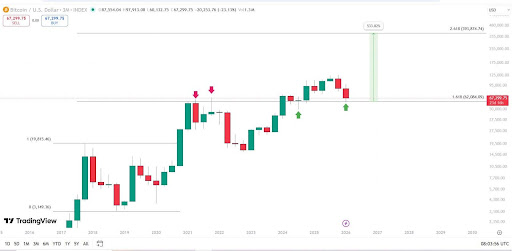
The chart accompanying the explanation highlights how Bitcoin historically reacts to this macro level. During the 2021 bull cycle, Bitcoin repeatedly failed to break and sustain price action above the 1.618 Fibonacci level. The analyst pointed to the second and fourth quarter candles of 2021, both of which were rejected at that same zone.
These repeated rejections signaled strong resistance at the time, reinforcing the significance of the level in the broader market structure. By mapping these macro levels across cycles, the analyst argues that long-term Fibonacci mathematics can help identify both extreme lows and potential expansion targets.
Quarterly Fibonacci Retest Suggests Next Macro Phase
The analyst’s latest chart interpretation suggests that Bitcoin’s relationship with the 1.618 Fibonacci level has shifted from resistance to support. After breaking above the $62,084 region on the quarterly timeframe, Bitcoin has not produced a quarterly candle close below the level since the breakout.
The chart shows two notable retests following the move. In the second and third quarters afterward, Bitcoin briefly tested the level but managed to hold above it on a closing basis. One quarterly wick even dipped below $50,000 before reclaiming the $62,084 level. As of the current quarter ending in March, Bitcoin is again trading above the same macro Fibonacci level. According to the analyst’s interpretation, this behavior represents a bullish quarterly retest.
The projection drawn on the chart extends toward the next Fibonacci expansion level at 2.618, which sits near $393,874. Gurjar describes this level as the minimum macro target if the structure holds. The chart also signals potential volatility, suggesting price wicks could stretch toward the $500,000 region during the expansion phase.
However, the analyst notes that deeper quarterly wicks remain possible depending on broader market conditions, including potential weakness in the altcoin market. Even with that caveat, the framework presents the current structure as a continuation pattern centered on Bitcoin holding the 1.618 Fibonacci level.













 Magyar
  English
  Română
  Eesti
Eesti  한국어
한국어  日本語
日本語  Русский
  Deutsch
  Español
  简体中文
简体中文  Français
  繁體中文
繁體中文  Português
  Italiano
  Polski
  Türkçe
  Nederlands
  Bahasa Indonesia
  Ελληνικά
  Українська
  Български
  Čeština
  Suomi
Suomi  Latviešu valoda
  Lietuvių kalba
  Norsk bokmål
  Slovenčina
  Slovenščina
  Svenska
Vélemény, hozzászólás?