
Bitcoin Magazine
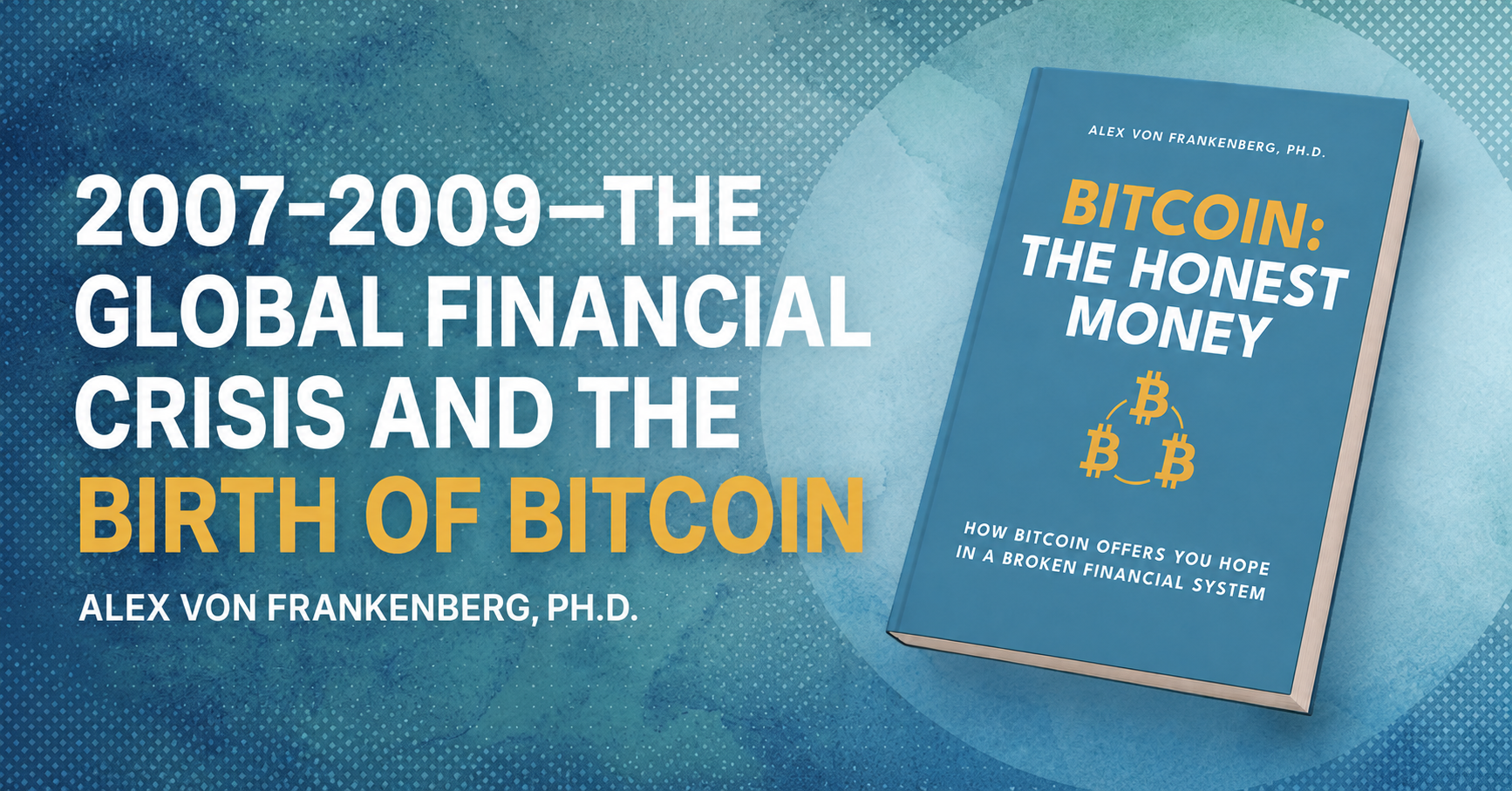
2007–2009—The Global Financial Crisis and the Birth of Bitcoin
On January 1, 2000, the world was supposed to end. As the date changed and the next millennium rolled in, computer systems programmed in the 1960s and 1970s were expected to crash. Storage space was very expensive back then. As a result, programmers often saved space by recording years with only two digits instead of four, omitting the century. Once the century changed, the logic would be lost, and systems would malfunction.
Massive IT projects were launched to fix the problem and prevent looming disasters, like nuclear power plants exploding. Alongside a booming tech industry, an even more booming survival industry emerged. Guidebooks were published on how to survive the impending catastrophe — hide under the table — while there was a healthy trade in bunkers and overpriced survival packs.
In a preemptive move, the U.S. Federal Reserve loosened monetary policy. The burgeoning internet and its early successes had brought technology to the masses. Together with loose financing conditions and growing public enthusiasm at the turn of the millennium, this ignited a unique boom on the stock markets, especially for tech and internet stocks.
The world did not come to an end. Instead, people started to wonder what would become of companies that had no chance of turning a profit and depended on continuous injections of investor funding. Doubts began to spread, share prices started to fall, and over the course of the year 2000, the dot-com bubble burst.
The final nail in the coffin of the 2000s bubble came on September 11, 2001. The terrorist attack on the World Trade Center in New York made it seem as though the world really was ending. Air traffic shut down, war broke out, and a recession followed. Stock markets plunged, and they just kept falling.
Once again, the U.S. Federal Reserve stepped in to save the economy and the financial markets. Interest rates were slashed, credit became cheap, and with this, the economic downturn was slowed. Starting in early 2003, the stock markets began to recover. Slowly at first, then faster. The exceptionally low interest rates stimulated economic activity, albeit not as intended. The burst tech bubble was soon replaced by a gigantic housing bubble, especially in the United States.
The film The Big Short begins with a quote from Mark Twain:
“It ain’t what you don’t know that gets you into trouble. It’s what you know for sure that just ain’t so.”
History provides us with many examples that show how stubbornly and for how long people, indeed entire societies, have clung to false beliefs. A good example is the geocentric worldview that many held in the Middle Ages: they believed that the universe revolved around the Earth. Galileo Galilei held an opposing belief and was threatened with death and excommunicated from the Church for it. The Church’s self-image and vested interests forbade such an inconvenient truth. But as it is with the truth, a point comes when it can no longer be denied.
The same was true of the financial crisis of 2007–2009. Behind many financial products on offer were mortgage-backed securities of little or no value. This truth, too, eventually could not be denied. The markets for these securities and the financial products built on them collapsed, along with a lot of the banks and financial institutions that held them. In the end, the entire financial system imploded. Major, well-known banks went bankrupt, financial markets dried up, and even healthy companies were put at risk of failure.
The terrifying yet fascinating part was the reaction of governments and central banks — through bailouts. With the exception of Lehman Brothers and a few others, virtually all the major institutions were saved. At the time, Chancellor Angela Merkel guaranteed the German public that their bank deposits were safe — a promise she likely could not have kept if it had been called out.
The central element of the bailouts was and still is the printing of money. Governments generously rescued important, systemically relevant banks and companies with the input of fresh money. Central banks financed and continue to finance this by purchasing government bonds, cutting interest rates, and providing very favorable financing conditions to banks.
This point is very important. When a central bank buys an outstanding government bond, that means it is increasing the money supply or printing money. In the film Oeconomia, Peter Praet, at that time the chief economist of the ECB, says this quite explicitly: “It is not physical money, but electronic.”
Printing money means increasing the amount of money in circulation. And that results in all of our money getting watered down. Ultimately, this makes it worth less since there’s more money but the same amount of goods.
When new money is created — that is, when money is inflated and then spent, no matter what it’s spent on — prices will eventually rise, and the money everyone else holds becomes less valuable. Put another way, when new money is created, everyone who already holds money is slightly dispossessed.
Only those who receive the new money first benefit, which is usually the banks, shareholders, and companies as well as borrowers and thus the government. Also benefiting are those who hold the goods or assets that are first purchased with the newly created money. This primarily includes real estate, stocks, and tangible assets in general.
Such inflation must be distinguished from individual price increases. If the demand for city-center locations suddenly rises because people are moving from the country to the city, property prices in city centers will rise, while they fall in the countryside. With inflation, prices rise almost everywhere. Price increases caused by rising demand or falling supply, such as after a poor harvest, are limited and are offset by a drop in prices elsewhere.
Inflation acts like a tax, but it isn’t perceived as such. The government could just as well take a small amount of money from every business and citizen to cover its spending instead of creating new money by issuing a government bond. In practice, it would be the same thing, only it wouldn’t be so easy, and many people would complain and might vote those politicians out in the next election.
Inflation is vague, and in public perception it’s not the government’s fault but rather that of others who are creating shortages of goods and profiting from rising prices. Political and public scapegoats for rising prices can always be found.
The former ECB chief economist, Peter Praet, states quite clearly that the functioning of today’s financial and economic system depends on the creation of more and more money — in other words, on continuous inflation. If the last financial crises have shown us anything, it’s the automatic reaction of governments: printing money. And crises will always keep coming for a variety of reasons: the ongoing climate crisis, pandemics, wars, migration, demographics, etc. Justification and excuses for printing money can always be found.
What does this have to do with Bitcoin?
A major and very valid criticism of a sound monetary system, in which money cannot be multiplied uncontrollably, is that it provides no way to intervene quickly by increasing the money supply in severe crises. That’s true. You would have to save beforehand, to set aside reserves.
And if there is one thing politicians cannot do, it’s save. There is always a good reason to spend money, whether it’s simply doing good, solving problems, winning over voters before an election, or even supporting a friendly entrepreneur in one’s own constituency.
The alternative would be to raise taxes in order to finance these unforeseen expenses. That would be politically and economically counterproductive. It would scare off voters and take away their purchasing power.
The crucial point is this: without the ability to print money at will, the boom that precedes a crisis wouldn’t arise in the first place, or at the very least would be much smaller. And the subsequent crises would also be a lot smaller. This is evident in the economic cycles of the 19th century, when a strict gold standard was in place.
Yes, there were numerous crises at the time. But they were short and less severe. And periods of falling prices certainly did not end in the dreaded deflationary spiral.
The ability to print unlimited amounts of money leads to correspondingly large misallocations, which then lead to correspondingly large corrections, and therefore, crises. These crises in turn trigger even more money-printing, and on it goes.
The greater the misallocations beforehand, the greater the corrections afterward. A healthy monetary system leads to sounder economic decisions, sustainable upturns, and brief downturns in which misallocations are corrected.
Money that cannot be arbitrarily multiplied limits misallocations during a boom, and accordingly, limits corrections during a downturn.
At the height of the financial crisis, on October 31, 2008, an anonymous person or group published the Bitcoin white paper — six weeks after Lehman Brothers, one of the largest banks in the U.S., filed for bankruptcy.
On January 3, 2009, Satoshi Nakamoto launched the Bitcoin blockchain. The very first block was mined. This first block contains the following message:
“The Times 03/Jan/2009 Chancellor on brink of second bailout for banks”
This was an explicit reference to a headline in The Times on January 3, 2009 — the repeated bailout of a financial system still teetering on the brink of collapse.
Bitcoin was, and still is, the answer to a fragile financial system: to uncontrolled money printing, to willful denial of reality, but also to the unfair and socially unjust expropriation that accompanies money creation.
The cap of 21 million bitcoin and the lack of central control make a policy of inflation impossible. Someone who holds bitcoin cannot be dispossessed by the uncontrolled printing of even more bitcoin.
Nor can they be dispossessed by banks that go bankrupt or deny access to bitcoin, provided they hold their bitcoin in a self-hosted wallet and thereby manage their own access. No central authority can revoke that access.
The timing of Bitcoin’s launch was no coincidence. It was the reaction to a financial system that would have collapsed had money not been printed in a pretty much uncontrolled manner.
Bitcoin is sound money — a response to a broken financial system. It is a system that is not imposed from above. Participation is voluntary and open to anyone. No one with a computer or smartphone and an internet connection can be excluded from it. For many, it’s a lifeline out of the fiat money system that is not sustainably viable.
In contrast to an inflationary and opaque system, Bitcoin is decentralized, transparent, and fundamentally honest.

Discover more in Bitcoin: The Honest Money!
This excerpt is just the beginning. Dive deeper into how inflation devalues your money, your savings, and your time in Bitcoin: The Honest Money by Alex von Frankenberg, Ph.D. The paperback is available now.
This post 2007–2009—The Global Financial Crisis and the Birth of Bitcoin first appeared on Bitcoin Magazine and is written by Alex v. Frankenberg.











 Magyar
  English
  Română
  Eesti
Eesti  한국어
한국어  日本語
日本語  Русский
  Deutsch
  Español
  简体中文
简体中文  Français
  繁體中文
繁體中文  Português
  Italiano
  Polski
  Türkçe
  Nederlands
  Bahasa Indonesia
  Ελληνικά
  Українська
  Български
  Čeština
  Suomi
Suomi  Latviešu valoda
  Lietuvių kalba
  Norsk bokmål
  Slovenčina
  Slovenščina
  Svenska
Vélemény, hozzászólás?