

John Bollinger, the creator of Bollinger Bands, used a sharply worded post on X on April 21 to argue that Bitcoin, XRP and the broader crypto market need a break from what he sees as capital being pulled out of the sector by Washington. Bollinger did not cite a dataset or name a specific policy move, but his reference to the “current administration” landed in a market already primed to read that as a swipe at President Donald Trump’s orbit and the crypto ventures tied to it.
“Can’t help but wonder if the current administration is done sucking capital out of the crypto space. Perhaps one of you can figure out how much capital they have removed from the space and make an estimate of the impact.” He then added the line that gave the post its sting: “Be nice to get back to business!” Bollinger tagged BTC, ETH, LTC and XRP, making clear he was talking about market-wide conditions rather than a single trade or narrative pocket.
The Story Behind Bollinger’s Bitcoin, XRP And Crypto Thesis
Bollinger’s complaint, read in context, is that crypto has spent too much time functioning as a political extraction machine and not enough time trading on its own fundamentals. That is an inference from his post, not a quantified claim by Bollinger himself, but it fits a period in which Trump-linked projects have absorbed enormous attention, liquidity and fee generation.
The clearest example was the TRUMP meme coin. Entities behind the token accumulated close to $100 million in trading fees in less than two weeks after launch, while tens of thousands of smaller traders lost money. 80% of the token supply was owned by CIC Digital, a Trump business affiliate, and another related entity, meaning a large share of the economics sat with insiders from the start.
Then there is World Liberty Financial, the Trump family-backed crypto venture that has become a much larger and more durable capital sink. World Liberty raised more than $550 million through sales of WLFI governance tokens, that the Trump family took a 60% stake in the business and rights to 75% of net token-sale revenue and 60% of operating revenue, and that only about 5% of the funds raised were left to build the platform itself.
New token sales still send 75% of proceeds to the Trump family, even as the project proposed tighter lockups for early investors and faces a fresh lawsuit by TRON founder Justin Sun.
That does not prove that money flowing into Trump-linked projects is money directly taken from Bitcoin or XRP on a one-to-one basis. But it does support the broader market argument Bollinger was making: in a cycle where capital is finite, politically branded tokens, insider-heavy token sales and fee-rich speculative launches can divert risk appetite away from liquid majors and the business of trading them.
If that dynamic eases, Bollinger’s call for “relief” may resonate most with investors who think Bitcoin and XRP have spent the last year competing not just with macro headwinds, but with the administration’s own crypto cash registers.
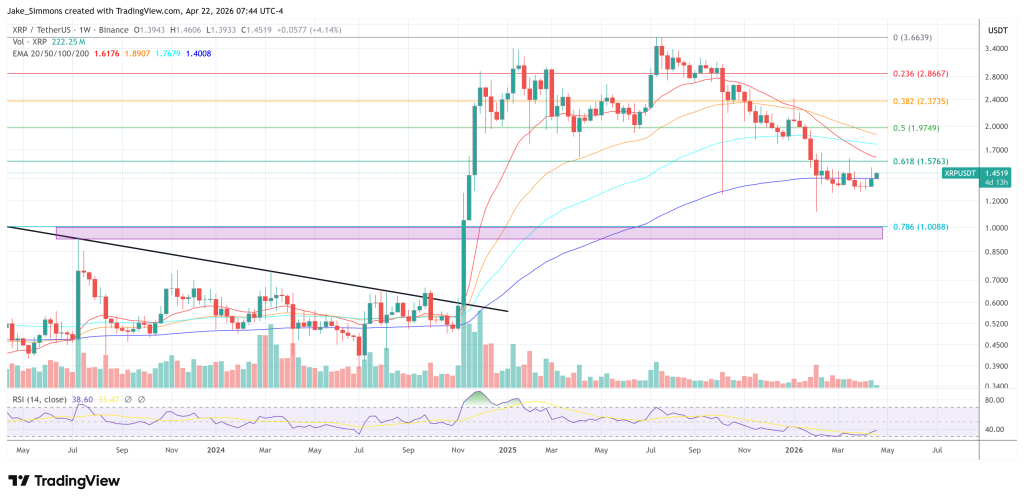
At press time, XRP traded at $1.45.










 Eesti
Eesti  English
  Română
  한국어
한국어  日本語
日本語  Русский
  Deutsch
  Español
  简体中文
简体中文  Français
  繁體中文
繁體中文  Português
  Italiano
  Polski
  Türkçe
  Nederlands
  Bahasa Indonesia
  Ελληνικά
  Українська
  Български
  Čeština
  Suomi
Suomi  Magyar
  Latviešu valoda
  Lietuvių kalba
  Norsk bokmål
  Slovenčina
  Slovenščina
  Svenska
Lisa kommentaar