

Bitcoin is currently knocking on the door that helped it bounce during the February crash at $60,000. The asset dumped toward $61,000 earlier today, which was hard to imagine just a few weeks ago when it traded above $82,000.
So, what could have prompted this massive 25% crash in well less than a month?
Investor Exodus
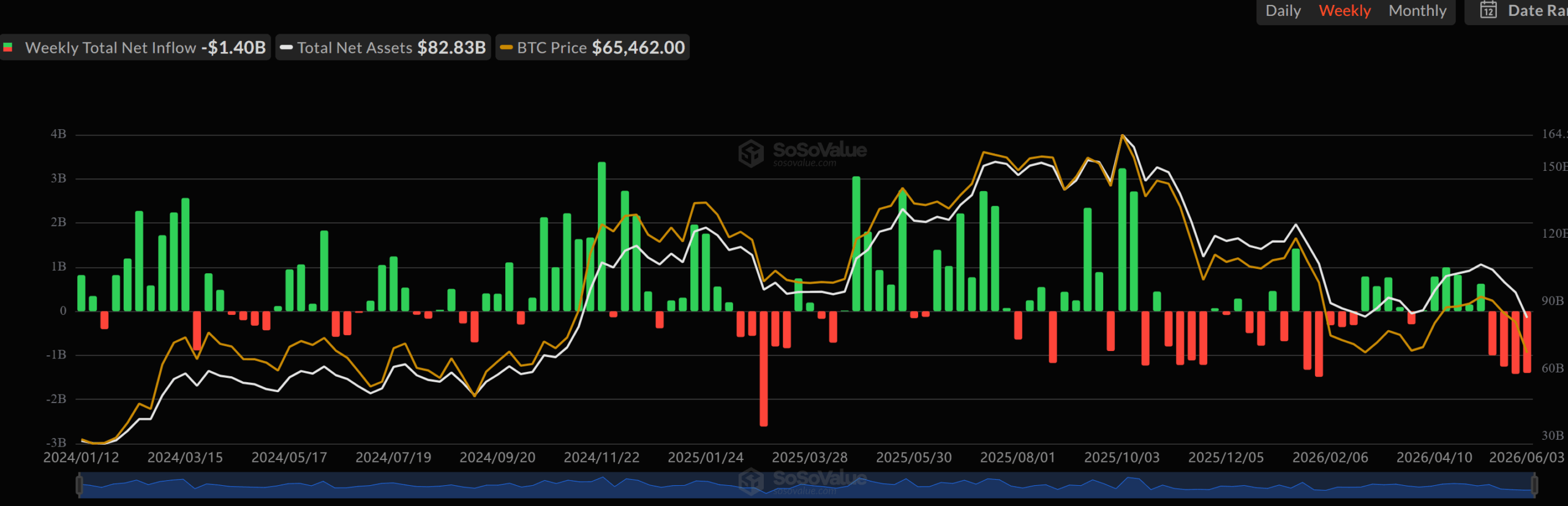
In general, falling prices require somebody selling, right? And it has to be in large quantities. The first that comes to mind are investors who had BTC exposure through the spot Bitcoin ETFs in the US. A simple look at the data provided from SoSoValue paints a clear and painful picture.
The funds have been deep in the red for 13 consecutive days, with the net outflows exceeding $500 million, $600 million, and even $700 million on some occasions. The net withdrawals have been in the billions of dollars for four straight weeks. The current one, even though the data is presented only until Wednesday, is on track to break the record, with already $1.4 billion in outflows.
This behavior is in stark contrast to the developments that took place by mid-May, when investors were rushing to pour funds into the ETFs.
But, it’s not just ETF investors. Data shared by Ali Martinez shows a substantial uptick in the number of BTC sent to exchanges over the past week alone. Roughly 54,000 BTC (valued at $3.35 billion at today’s prices and at almost $3.8 billion when the transfers began) found their way to trading platforms, with the likely intention to be sold off.
54,000 Bitcoin bitcoin:native moved onto trading platforms over the past week. This spike in available supply of roughly $3.78 billion has increased short-term selling pressure, driving the price down to $65,300. https://t.co/AXEpKJPyND pic.twitter.com/pa5WPZXzUt
— Ali Charts (@alicharts) June 3, 2026
Strategy also sold. Yes, this one was speculated for weeks, but the actual confirmation could have been the necessary trigger for some investors to lose hope. Although the company disposed of a tiny portion of its massive BTC stash, the move was still categorized as bearish by many critics.
Mt. Gox also spread some FUD into the already fragile market, as on-chain data shows new BTC transfers to exchanges completed recently.
Iran-US and AI
A more macro reason came from the war front between the US and Iran (and several nearby nations). After weeks of a ceasefire but unsuccessful permanent peace negotiations, the US and Iran reinitiated the attacks against each other, which now involve Kuwait and other countries in the region as well.
History shows that risk-on assets like BTC do not react well to escalating war tensions. Recall that the asset dumped by several grand immediately after the initial strikes began in late February.
Lastly, Michael Saylor outlined the massive growth and hype of the artificial intelligence sector. He believes there’s a clear correlation between investor exodus from crypto and booming AI prices, which continues to harm the former’s progress. Nevertheless, he actually noted that such moments present opportunities.
Capital markets are funding the AI buildout at historic scale: ~$400B over 6 months. Bitcoin ETFs have seen ~$4B of outflows since May 14, pressuring $BTC. This is a capital rotation, not a Bitcoin impairment. Volatility creates opportunity.
— Michael Saylor (@saylor) June 4, 2026
So, What’s Next?
As usual, most crypto analysts are split on what could be around the corner for BTC. Some think a rebound is in the making, while others outlined lower price targets. Ali Martinez stands in the second corner. Basing his analysis on the MVRV pricing bands, he öngörülen that BTC could be on its way down to $55,000 or even $50,000. It’s worth noting that the cryptocurrency hasn’t traded at such low levels for almost two years.
CryptoQuant’s CEO, though, noted that there’s one major difference between bitcoin’s current state and that of two years ago. Although the price is relatively similar, he noted that short-term holders are “evolving into long-term holders” now, as the percentage of holdings from investors who had bought from 6 months to 2 years ago is up to 53% from 15% back in 2024.
Bitcoin is at the same price as two years ago, but one thing is different.
The 6m–2y cohort, who joined this cycle, now holds 53% of realized cap, up from 15% two years ago. Last cycle, Bitcoin bottomed when this hit 68%.
Short-term holders are evolving into long-term holders. pic.twitter.com/tfmLz3mFPS
— Ki Young Ju (@ki_young_ju) June 4, 2026
Gönderi Bitcoin’s $20K Collapse: 6 Reasons Behind the Crash and What Happens Next? ilk olarak şurada yayınlandı CryptoPotato.












 Türkçe
  English
  Română
  Eesti
Eesti  한국어
한국어  日本語
日本語  Русский
  Deutsch
  Español
  简体中文
简体中文  Français
  繁體中文
繁體中文  Português
  Italiano
  Polski
  Nederlands
  Bahasa Indonesia
  Ελληνικά
  Українська
  Български
  Čeština
  Suomi
Suomi  Magyar
  Latviešu valoda
  Lietuvių kalba
  Norsk bokmål
  Slovenčina
  Slovenščina
  Svenska
Bir yanıt yazın