

Bitcoin’s recent break above $70,000 is leading to questions of whether this is the start of a new impulsive leg higher or just another stop in a longer bottoming process.
Crypto analyst CrypFlow, posting on X, laid out a technical case for why Bitcoin may be in the early stages of forming a major cycle bottom and why October 2026 could mark the launchpad for the next full-scale bull run. The analysis is based on multi-year trendlines, cycle behavior, and the Stochastic RSI indicator.
Bitcoin Is Respecting Trendline That Has Held Since 2018
Technical analysis of Bitcoin’s price action on the monthly timeframe shows that the leading cryptocurrency’s price action is still respecting a multi-year trendline that has quietly shaped Bitcoin’s biggest cycle lows. That ascending trendline connects the 2018 cycle bottom with the 2022 bottom and now appears to be acting as support again in 2026. Bitcoin’s current position is now sitting right on top of that structure.
CrypFlow also pointed to a major horizontal zone that previously acted as resistance around the 2021 cycle top. That old ceiling around $69,000 is now being tested as support in the current price action. That kind of role reversal is very important for Bitcoin’s price action, because it shows the cryptocurrency may be trying to build a base at the intersection of that old resistance band and the rising trendline.
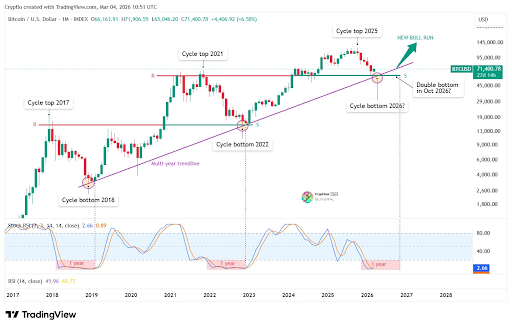
If Bitcoin manages to stay above the current zone near $69,000 without falling to the $50,000 region, it would mirror the structure seen at the 2022 bottom. That low formed at a similar confluence where the rising trendline met the previous cycle’s resistance from the 2017 peak.
Timeline For A New Bull Run
Price levels get all the attention. Time gets almost none, and according to CrypFlow, that is precisely where most people are getting this cycle wrong. The analyst pointed to the Stochastic RSI to track how long this indicator has spent below the zero line during each major bear market cycle, and the historical pattern is striking in its consistency.
In the 2018/2019 cycle, the Stochastic RSI spent approximately 365 days below zero before Bitcoin mounted its real reversal and the next bull market began. The same held true in the 2022/2023 bear market cycle, where Bitcoin spent roughly one full year below zero before the sustained recovery kicked in. This cycle, however, Bitcoin’s Stochastic RSI has only been below zero for around 120 days.
Putting it all together, this opens up a scenario where Bitcoin forms a double bottom later this year, likely around October 2026, before the next major bull run begins. This doesn’t necessarily mean Bitcoin is about to crash further. What it does suggest, according to CrypFlow, is that the price action hasn’t completed the slow, grinding work that true cycle bottoms are built on.













 Slovenščina
  English
  Română
  Eesti
Eesti  한국어
한국어  日本語
日本語  Русский
  Deutsch
  Español
  简体中文
简体中文  Français
  繁體中文
繁體中文  Português
  Italiano
  Polski
  Türkçe
  Nederlands
  Bahasa Indonesia
  Ελληνικά
  Українська
  Български
  Čeština
  Suomi
Suomi  Magyar
  Latviešu valoda
  Lietuvių kalba
  Norsk bokmål
  Slovenčina
  Svenska
Dodaj odgovor