

Bitcoin Magazine

The Business Owner’s Guide to Vertical Integration with Bitcoin
While Bitcoin is often viewed strictly as a financial asset, a growing number of 2026 operators are treating it as something entirely different: a stack of operational capabilities to vertically integrate.
In traditional manufacturing, vertical integration is one of the oldest competitive moves in the playbook. A car company that owns its tire factory is vertically integrated; Apple, by owning its silicon, operating system, storefront, and device, is the modern textbook case. The structural advantages, lower costs, fewer dependencies, and tighter control over quality, are now being claimed by companies integrating Bitcoin into multiple stages of how they produce, hold, move, and earn money. The businesses furthest along this path aren’t necessarily those with the largest treasuries, but those that treat Bitcoin as a core infrastructure.
This article is the operator’s guide to that decision. We define the vertical integration of Bitcoin in concrete terms, lay out the four stages every integrated company moves through, provide a diagnostic to figure out how far you should climb, and deliver a sequenced roadmap for getting there.
What “vertical integration” means when applied to Bitcoin
In the classical sense, vertical integration means owning multiple stages of your supply chain rather than renting them. A vertically integrated business produces its own inputs, makes its own product, and controls its own distribution. Each stage feeds the next. Each stage adds margin that would otherwise leak to a vendor.
Applied to Bitcoin, vertical integration means owning multiple stages of how your business interacts with Bitcoin, rather than renting any single piece of it. The four stages are:
- Accept: taking Bitcoin from your customers as payment, instead of (or alongside) cards and ACH
- Hold: putting Bitcoin on your balance sheet as a treasury reserve asset, instead of (or alongside) cash
- Produce: generating Bitcoin yourself by mining, converting electricity and hardware into BTC at cost
- Build: offering Bitcoin products, infrastructure, or financial instruments to other businesses or to investors as a revenue line
A company that does all four owns the full operational stack. A company that does two has integrated partially. A company that does one is using Bitcoin but not yet integrated. None of these are wrong. But the deeper the integration, the more durable the strategic position, because each stage feeds the next. Payments fund reserves. Reserves enable productive deployment and underwrite financial products. Financial products attract capital that funds more reserves. Productive deployment generates more Bitcoin. The flywheel runs in this direction for a reason.
Stage 01: Accept
The first stage is taking Bitcoin from your customers. For most businesses with a payment terminal or a checkout flow, accepting Bitcoin via the Lightning Network is the lowest-friction entry into the integrated stack. The economics are not subtle. Credit card processing typically costs 2.5% to 3.5% per transaction, settles in two to three business days, and exposes the merchant to chargeback risk. Lightning settles in seconds, costs less than 0.1%, and is final on receipt.
The clearest case study is Steak ‘n Shake. The chain enabled Lightning payments across all U.S. locations in May 2025. At the Bitcoin 2026 Conference, executive Michael Boes reported that the company saves approximately 50% on processing fees when customers pay with Bitcoin compared to traditional credit card transactions, and that universal Bitcoin adoption among its customer base would translate to roughly $6 million in annual savings. Same-store sales rose 11% in Q2 2025 and accelerated to 15% in Q3.
What makes Steak ‘n Shake an integration case rather than just a payments case is what happens after the customer pays. Bitcoin payments do not get auto-converted to dollars. They flow into a Strategic Bitcoin Reserve on the company’s balance sheet, which underwrites a $0.21-per-hour Bitcoin bonus paid to hourly employees and helps fund a menu overhaul that includes 100% grass-fed beef. Stage 01 (Accept) is wired directly into Stage 02 (Hold). The savings on the payment rail do not sit in a P&L line. They become inventory in the strategic reserve.
This is the first principle of vertical integration applied to Bitcoin. A move taken in isolation is just a feature. A move wired to another stage is integration.
For many operators, Stage 01 is no longer a project. As of March 30, 2026, Square switched on Bitcoin Lightning payments by default for eligible merchants globally, covering approximately 4 million businesses. Bitcoin payments through Square are free through 2026, with a 1% flat fee applying from 2027. The first stage of the integrated stack is effectively the default for most merchants. The integration question is whether you wire the inflow to the next stage or let it auto-convert to fiat and disappear.
A side-by-side, on a $100 transaction:
| Metric | Legacy stack | Bitcoin via Lightning |
|---|---|---|
| Processing fee | 2.90% | <0.1% |
| Settlement time | 2 to 3 days | Seconds |
| Chargeback risk | Yes | Zero |
| Cross-border | FX spread added | Native |
| Net to operator | $97.10 | $99.90+ |
Stage 02: Hold
The second stage is putting Bitcoin on your balance sheet. Where Stage 01 is a payments decision, Stage 02 is a treasury decision. The question every CFO has had to answer for a century is where to park retained earnings.
The default answer of cash and short-term Treasuries is a slow leak when measured against a fixed-supply asset. Stage 02 says a portion of the company’s reserves should be denominated in something that cannot be diluted by anyone, including its issuer.
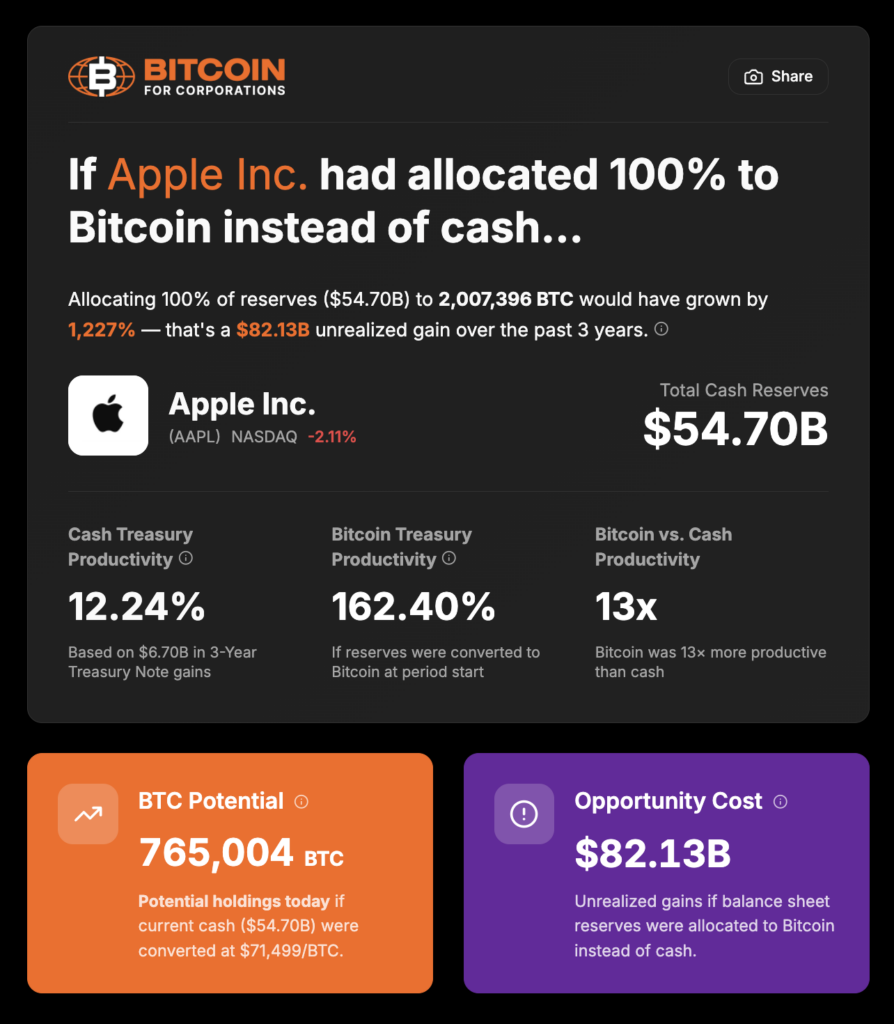
Try the Bitcoin Treasury Simulator with any stock ticker.
The canonical example is the work Michael Saylor began in August 2020, when his company (then MicroStrategy, now Strategy) became the first major public corporation to declare Bitcoin its primary treasury reserve asset. As of June 1, 2026, Strategy holds 843,706 BTC at an average cost basis of approximately $75,500 per coin, an aggregate position of $60.4 billion that represents nearly 4% of all Bitcoin in existence. Saylor’s argument was never that Bitcoin would go up. It was that cash was going down, and the right unit of account for a long-duration corporate treasury was the asset with the most credible scarcity.
Strategy is the deepest expression of Stage 02 in existence, but it is not the only shape this stage can take. Mining companies like Marathon and Riot hold mined production rather than selling it. Metaplanet in Japan has built a similar accumulation strategy in the Asian market, providing yen-denominated Bitcoin exposure through a Tokyo-listed structure. Block holds 8,997.89 BTC in its corporate treasury, separated from a further 19,357 BTC held in custody for Cash App customers, and verifies the distinction on-chain through quarterly Proof of Reserves disclosures.
Most operators will not run a 100% Bitcoin treasury. They do not have to. Even a 1% to 5% allocation of retained earnings is a meaningful hedge, and the policy decision to denominate a slice of the balance sheet in Bitcoin is more important than the size of that slice. The board resolution comes first. The accumulation comes after.
A note on custody, which is part of this stage and not separable from it. Holding Bitcoin without controlling the keys is not actually holding Bitcoin. Operators integrating Stage 02 should set up institutional multi-signature cold storage from day one to maximize balance sheet sovereignty. The cost of getting custody wrong is total. The cost of getting it right is a one-time setup fee and a quarterly verification routine.
Stage 03: Produce
The third stage is generating Bitcoin yourself, by mining. This is the most operationally intense stage in the stack and the most niche, but it is also the one that gives the integrated operator the deepest cost advantage. The cost basis of mined Bitcoin is your cost of power and amortized hardware, typically far below the market price of BTC itself. For the right kind of business, that gap is structural margin that no competitor can replicate without similar inputs.
Stage 03 is not for most operators. It requires industrial-scale operations, low-cost electricity (often dedicated power purchase agreements or stranded energy), and operational expertise in data center management. The pure-play public-market exemplars are Marathon Digital (MARA), with roughly 50,000 BTC accumulated almost entirely through self-mining, and Riot Platforms, with approximately 19,000 BTC. Their cost basis is not a market price. It is electricity, hardware depreciation, and operational scale.
What makes Stage 03 integrated rather than isolated is the connection to Stage 02. Both Marathon and Riot retain the majority of their mined production rather than selling it on the open market. The mining operation feeds the treasury directly. Each block reward is inventory for the strategic reserve, denominated in the same asset the company is accumulating long-term.
What makes Stage 03 newly accessible in 2026 is who else is moving into it. Block, through its Proto division, is developing an open-source 3-nanometer custom ASIC chip and a complete mining system designed to make industrial-grade mining accessible to operators who are not themselves miners. The strategic implication is that production is becoming a primitive any sufficiently committed operator can adopt, particularly those with stranded power assets, surplus electricity, or operational synergies with existing energy businesses. A power utility, a data-center operator, an industrial real-estate holder, or a company sitting on cheap behind-the-meter power can now consider Stage 03 in a way that would have been unrealistic five years ago.
For most readers of this article, Stage 03 will not be the right move to integrate. The capital and operational requirements are too specific to most business models. But for the subset whose existing business already produces or controls the inputs, this is the stage with the largest structural margin advantage and the most defensible moat.
Stage 04: Build
The fourth and deepest stage is offering Bitcoin products, infrastructure, or financial instruments to other businesses or to investors, capturing fees, network effects, distribution, or capital as a result. Where the first three stages are about using Bitcoin internally, Stage 04 is about selling Bitcoin-related services and products externally. It is the stage that converts the integrated operator from a Bitcoin user into a Bitcoin business.
Four sub-categories matter inside Stage 04, and they map to different kinds of businesses.
Custody products. Bitkey (a Block product), Casaoraz Unchained sell secure Bitcoin storage as a service. The market exists because every Stage 02 operator needs a custody solution and few want to build one in-house. The business model is subscription, hardware sales, and institutional service fees.
Network infrastructure. LQWD Technologies (TSXV: LQWD) is the clearest example. The company holds 262 Bitcoin, with no debt or convertible obligations against the position, but the Bitcoin is not in cold storage. It is deployed as liquidity across a global network of enterprise-grade Lightning nodes, where it earns routing fees on every transaction it helps settle. CEO Shone Anstey has noted the Lightning Network now processes over $1 billion in monthly transaction volume, and LQWD’s own infrastructure has routed more than two million transactions and over 2,012 Bitcoin since launch. The novelty is that the same Bitcoin functions simultaneously as a Stage 02 balance-sheet asset and as Stage 04 productive infrastructure earning fees in the same asset, without selling, lending, or staking it.
Consumer products. Cash App is the most-used Bitcoin on-ramp in the United States, with millions of consumers buying, sending, and now automatically earning Bitcoin through routine app activity. Strike serves a parallel function with a Lightning-first design and global remittance focus. River targets long-term Bitcoin accumulators with low-fee dollar-cost averaging and account-level Lightning support. The strategic point of consumer distribution is moat. A company that owns the on-ramp does not just earn fees, it shapes how an entire generation forms its relationship with the asset.
Bitcoin-backed financial products. This is the fastest-growing sub-category and the one most operators have not yet recognized as part of Stage 04. Strategy is the canonical case. Beginning in 2024 and accelerating through 2026, Strategy has built a full preferred stock suite designed to give institutional and retail investors exposure to Strategy’s Bitcoin treasury thesis without holding Bitcoin directly. The suite currently includes STRF (10% perpetual strife preferred), STRC (variable rate perpetual stretch preferred, currently yielding 11.50% annually paid monthly), STRK (8% perpetual strike preferred), STRD (10% perpetual stride preferred), and STRE. Together, these products represent over $30 billion in remaining issuance capacity under active at-the-market programs.
Saylor describes the category as “digital credit” — an emerging asset class of income instruments built on Bitcoin treasury balance sheets. STRC in particular, with its variable rate, monthly cash payment, and par-targeting mechanism, is designed to compete directly with money market funds and short-duration fixed income.
View the STRC Tracker for live data on Strategy’s Bitcoin accumulation.
The $43+ billion Strategy has raised across equity, preferred, and convertible debt in less than two years has been deployed into Bitcoin acquisition. The reflexive flywheel is the part worth studying closely: the larger Strategy’s Bitcoin treasury grows, the stronger the collateral story behind the preferred stock, the better the preferred stock prices, the more capital it raises, the more Bitcoin Strategy can buy. Stage 04 (Build) and Stage 02 (Hold) reinforce each other directly. This is the integration.
The same model is now being adapted by other operators. Bitcoin-collateralized lending products, structured notes, exchange-traded products, and ABCP-style facilities using Bitcoin treasury equity as underlying collateral are all extensions of the digital credit thesis. For operators with sufficient Bitcoin treasury scale, Stage 04 financial products can become the dominant mechanism by which Stage 02 funds itself.
How to decide how far to integrate
Not every business should integrate all four stages. The right depth depends on what the business already does, what assets it already controls, what kind of capital it can access, and what kind of operational complexity its leadership can absorb. The diagnostic below is the simplest version of the question every operator should answer before choosing how deep to go.
Question 01. Do customers pay your business directly?
If yes, Stage 01 is available immediately and produces measurable value from the first transaction. If most revenue is invoiced or B2B, Stage 01 still applies but the implementation shifts toward Bitcoin invoicing rather than point-of-sale. If the business has no customer payment flow, integration starts at Stage 02 instead.
Question 02. Does your business carry retained earnings or cash reserves on its balance sheet?
If yes, Stage 02 is available at any size from 1% to 100% of reserves. If the business runs lean with no meaningful cash position, Stage 02 is premature and integration begins or ends at Stage 01.
Question 03. Do you control cheap electricity, stranded energy, or capital scale that could support an industrial mining operation?
If yes, Stage 03 becomes feasible and adds the deepest cost-basis advantage in the stack.
If no, Stage 03 should be skipped, not deferred. Most operators will integrate Stages 01, 02, and 04 without ever touching Stage 03.
Question 04. Do you have a technology or platform business, or a balance sheet large enough to support Bitcoin-backed financial products as new revenue?
If yes, Stage 04 is the natural extension of existing capabilities, and the relevant sub-category (custody, infrastructure, consumer, financial products) should match your existing competencies. A fintech goes to consumer products. An infrastructure company goes to network operations. A hardware firm goes to custody devices. A capital-markets-active operator with significant Bitcoin treasury goes to financial products.
Most operators reading this article will land in one of five integration patterns:
| Pattern | Stages owned | Best for |
|---|---|---|
| Single-Stage Operator | One stage | Operators testing the integration thesis with their lowest-risk move |
| Operations Pragmatist | Stages 01 + 02 | Operators with both customer payments and a balance sheet (Steak ‘n Shake template) |
| Capital Markets Pragmatist | Stages 02 + 04 | Operators with significant Bitcoin treasury and capital-markets capability (Strategy template) |
| Builder | Three stages, including Stage 04 | Tech, financial, or platform businesses adding Bitcoin as a revenue line |
| Maximalist | All four stages, fully integrated | Operators whose core business is built around Bitcoin (Block template) |
The two Pragmatist patterns are worth studying side by side. Both are two-stage integrations. Both wire one stage into another to create a flywheel. But the flywheels run on different inputs and produce different outputs. Steak ‘n Shake’s flywheel runs on customer payments and produces a growing reserve. Strategy’s flywheel runs on capital markets and produces a growing reserve. The destination is the same. The mechanism is different.
Each pattern is a legitimate integration posture. The deeper the integration, the larger the structural moat, but also the larger the operational complexity. Most operators reading this article will and should land in one of the two Pragmatist patterns or in the Builder pattern. Few will be Maximalists. That is the correct distribution.
Three integration patterns, in practice
To make the patterns concrete, here are three companies that exemplify three different shapes and depths of integration in 2026:
Block: the Maximalist. Block owns all four stages. Square (Stage 01), an 8,998 BTC corporate treasury verified on-chain (Stage 02), Proto mining hardware (Stage 03), and Bitkey, Cash App, and Spiral (Stage 04). The total company-wide Bitcoin position, including custodied customer assets, is 28,355 BTC. Block is the working proof that vertical integration of Bitcoin can live inside a single corporate structure across all four stages, and that the integration produces compounding strategic advantages no single-stage competitor can replicate. The takeaway for most operators is not to copy Block. It is to recognize that the integrated maximalist position is now demonstrably possible, which means none of the four stages are theoretical anymore.
Steak ‘n Shake: the Operations Pragmatist. Steak ‘n Shake owns Stages 01 and 02, wired tightly together. Bitcoin sales at the point of payment flow directly into the company’s Strategic Bitcoin Reserve, which underwrites both employee compensation and product reinvestment. Same-store sales rose 18% heading into 2026. Steak ‘n Shake is the practical case for most operators with customer-facing payment flows: pick the two stages your business model already supports, engineer the connection between them, and let each one strengthen the other. The integrated effect is more than additive. The reserve gives the payments program a strategic purpose, and the payments program gives the reserve an organic accumulation engine.
Strategy: the Capital Markets Pragmatist. Strategy owns Stages 02 and 04, wired into a reflexive flywheel that has raised over $43 billion in less than two years. The 818,334 BTC reserve (Stage 02) underwrites the credibility of Strategy’s preferred stock suite (Stage 04), and the preferred stock suite raises capital that funds further Bitcoin acquisition for the reserve. STRC alone, with $30+ billion in remaining ATM issuance capacity across the full preferred stack, demonstrates that Bitcoin-backed financial products can scale to institutional volume. Strategy is the practical case for capital-rich operators with the balance sheet to issue financial products: pick Hold and Build, wire them together, and let capital markets compound the reserve faster than operating cash flow ever could.
The pattern across all three is that vertical integration in Bitcoin does not require maximalism. What it requires is intentionality. Each stage has to be chosen because it fits the business, and each connection between stages has to be engineered deliberately. The operators who get this right end up with structural advantages their competitors cannot easily replicate. The operators who treat Bitcoin as a single decision (buy or don’t) miss the architecture entirely.
A reference map
| Operator | Stage 01: Accept | Stage 02: Hold | Stage 03: Produce | Stage 04: Build | Pattern |
|---|---|---|---|---|---|
| Block (NYSE: XYZ) | Primary | Primary | Primary | Primary | Maximalist |
| Strategy (NASDAQ: MSTR) | - | Primary | - | Primary | Capital Markets Pragmatist |
| MARA Holdings (NASDAQ: MARA) | - | Primary | Primary | - | Producer-Holder |
| Riot Platforms (NASDAQ: RIOT) | - | Primary | Primary | - | Producer-Holder |
| Steak ‘n Shake (private) | Primary | Supporting | - | - | Operations Pragmatist |
| LQWD Technologies (TSXV: LQWD) | - | Supporting | - | Primary | Builder |
| Metaplanet (TYO: 3350) | - | Primary | - | - | Single-Stage Operator |
A sequenced integration roadmap
Vertical integration is not built in a single quarter. It is sequenced. The order of operations matters because each stage builds on the one before it, and each stage requires organizational and operational learning that the next stage assumes. The roadmap below is the path most successfully integrated operators have followed, and the order most operators starting today should follow.
Quarter 1 to 2 — Adopt Stage 01. Enable Bitcoin Lightning payments through Square or a comparable processor. For Square merchants, this is now a setting rather than a project. Decide whether incoming Bitcoin is auto-converted to fiat or held in a wallet. Most operators should auto-convert at first while custody and treasury policy are being formalized.
Quarter 2 to 4 — Build the foundation for Stage 02. Set up institutional multi-signature custody before any meaningful Bitcoin position accumulates. Draft and pass a board policy that defines Bitcoin as a treasury reserve asset and authorizes a target allocation, even if the initial allocation is 1% of retained earnings. Maintain 6 to 12 months of operating expenses in fiat as a buffer.
Quarter 4 onward — Wire Stage 01 to Stage 02. Stop auto-converting incoming Bitcoin payments. Route them directly into the strategic reserve. This is the moment integration becomes real. The payments program is no longer a cost-savings initiative. It is an organic Bitcoin accumulation engine that the operator does not have to fund externally. At this point, the operator has reached the Operations Pragmatist pattern.
Year 2 — Evaluate Stage 04 if applicable. For technology, financial, or platform businesses, the second year is the right time to evaluate whether Bitcoin can become a revenue line and which sub-category fits. For operators whose Bitcoin treasury has grown large enough to anchor capital markets activity, financial products become a credible Stage 04 path. For most other operators, integration concludes at the Operations Pragmatist pattern.
Year 3+ — Evaluate Stage 03 if applicable. Mining is the last stage to consider because it requires the most capital, the most operational expertise, and the most clarity about long-term Bitcoin commitment. For operators with energy assets or stranded power, the calculus may justify earlier entry. For most others, Stage 03 is permanent skip rather than deferred consideration.
By Year 3, an operator who has followed this roadmap has built a vertically integrated Bitcoin position that no competitor can replicate without making the same multi-year commitment. The integration is the moat. The Bitcoin position is the byproduct.
The bottom line
Vertical integration of Bitcoin is not a maximalist posture. It is a strategic posture. It can be expressed at any depth from one stage taken seriously to four stages fully wired together, and the patterns vary by which two stages an operator chooses to pair. Steak ‘n Shake pairs Accept with Hold. Strategy pairs Hold with Build. Both are two-stage integrations. Both produce reflexive flywheels. The mechanisms are different. The strategic posture is the same.
What separates an integrated Bitcoin operator from one who has merely bought Bitcoin is the connection between stages. Payments feed reserves. Reserves underwrite financial products. Financial products attract capital that funds more reserves. Productive deployment generates more Bitcoin. The flywheel runs in this direction because each stage produces inputs the next stage consumes.
For most operators in 2026, the right path is the Operations Pragmatist pattern. Stages 01 and 02, tightly coupled, executed over four to six quarters. Steak ‘n Shake is the template. For capital-rich operators with significant Bitcoin treasury and capital-markets capability, the Capital Markets Pragmatist pattern is the more powerful play. Strategy is the template. The companies that will define the next decade of corporate finance are not the ones with the largest Bitcoin holdings. They are the ones that turned Bitcoin into an integrated operating model, picked the right two stages for their business model, and let the connections between the stages compound into a structural advantage their competitors cannot match.
Pick your pattern. Build the connections. Let the integration do the work.
Disclaimer: This content was prepared on behalf of Bitcoin For Corporations for informational purposes only. It reflects the author’s own analysis and opinion and should not be relied upon as investment advice. Nothing in this article constitutes an offer, invitation, or solicitation to purchase, sell, or subscribe for any security or financial product.
This post The Business Owner’s Guide to Vertical Integration with Bitcoin first appeared on Bitcoin Magazine and is written by Nick Ward.











 Polski
  English
  Română
  Eesti
Eesti  한국어
한국어  日本語
日本語  Русский
  Deutsch
  Español
  简体中文
简体中文  Français
  繁體中文
繁體中文  Português
  Italiano
  Türkçe
  Nederlands
  Bahasa Indonesia
  Ελληνικά
  Українська
  Български
  Čeština
  Suomi
Suomi  Magyar
  Latviešu valoda
  Lietuvių kalba
  Norsk bokmål
  Slovenčina
  Slovenščina
  Svenska
Dodaj komentarz